

Disability support services is one of the sectors the Fair Work Ombudsman named as a compliance priority for the current financial year, and the numbers behind that focus are hard to ignore. The regulator recovered $358 million for more than 249,000 underpaid workers in 2024 to 2025 alone, and a growing share of its casework is now landing on community services and disability employers whose payroll systems simply were not built to interpret the award correctly, according to enforcement analysis published by Lexology.
Fair Work Ombudsman underpayment findings in this sector are rarely about deliberate wrongdoing, they are almost always a payroll system problem.
If you employ support workers under the Social, Community, Home Care and Disability Services Industry Award 2010, better known as SCHADS, this is the environment your payroll process now operates in. SCHADS Award payroll is not a back-office detail here, it is the thing your compliance risk actually hinges on.
So when providers search for the best payroll software for NDIS providers with complex awards, they are usually not asking a generic question about NDIS payroll software in the abstract. They are asking whether a piece of software can actually keep up with an award that is, by most measures, one of the hardest in the country to administer correctly, and one that is about to change four times in the space of eighteen months.
Why SCHADS breaks generic payroll software
SCHADS covers more than 250,000 workers across disability, home care, social and community services, and crisis accommodation. It has eight classification levels spread across four streams: Social and Community Services, Crisis Accommodation, Home Care, and Family Day Care.
These SCHADS classification levels, combined with pay points and employment type and every applicable penalty, produce more than 3,000 possible pay rate combinations a single provider might need to apply correctly. Generic payroll software, the kind built for retail or hospitality rosters, has no concept of most of this. It can calculate a flat hourly rate and a standard overtime multiplier, and that is roughly where its usefulness ends.
Three features of the award cause the most damage when they are handled manually or by software that was not built around SCHADS specifically.
Penalty rates that take the highest applicable rate, not the sum of every rate
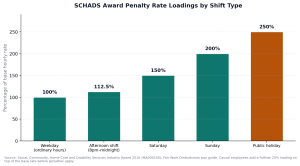
Ordinary weekday hours are paid at the base rate, but evening, weekend, and public holiday work all attract different loadings, and the highest applicable SCHADS penalty rate applies rather than the rates adding together.
| Shift type | Loading on base rate |
| Weekday, ordinary hours | 100% |
| Afternoon shift (8pm to midnight) | 112.5% |
| Saturday | 150% |
| Sunday | 200% |
| Public holiday | 250% |
Source: the SCHADS Award pay guide maintained by the Fair Work Ombudsman. Casual employees add a further 25% loading on top of the base rate before any of these penalties are calculated, and that loading does not compound with overtime.
This is exactly the layer generic payroll add-ons tend to skip. A spreadsheet, or a payroll tool with a single overtime rule bolted on, has no way of knowing that a Saturday evening shift takes the Saturday rate rather than stacking the Saturday and evening penalties together, and that mistake runs in both directions: some providers overpay by stacking penalties that shouldn’t combine, others underpay by defaulting to whichever rate a template happens to have pre-loaded.
Sleepover, broken shift, and on-call rules that don’t map to a normal timesheet
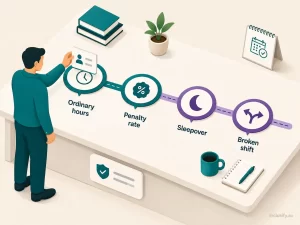
A sleepover shift is paid as a fixed sleepover allowance for the overnight period, plus ordinary rates for any active work performed during it, which means one shift can generate two different pay calculations depending on what actually happened overnight. Broken shifts, common in home and community care where a worker’s day is split by unpaid gaps, attract their own separate broken shift allowance. On-call periods carry a different allowance again.
Software that treats a shift as a single start and end time cannot represent any of these correctly, because the pay outcome depends on what happened inside the shift, not just its length.
Classification that depends on duties, not job title
A worker’s pay level under SCHADS is determined by the actual tasks and responsibilities of the role and the qualifications held, not by what their position is called in an employment contract. Two people with the same job title can sit on different pay points, and getting this classification wrong at the point of onboarding is one of the most common root causes of the underpayment cases the Fair Work Ombudsman investigates.
When classification lives as a structured, auditable field tied to each worker’s record, rather than a line in a contract nobody revisits, this kind of drift becomes far easier to catch before it compounds across a year of pay runs.
What one real shift actually costs to get right
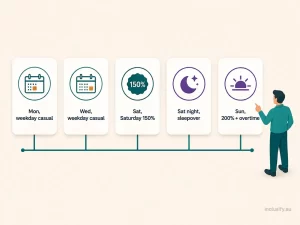
The easiest way to see why this award defeats flat-rate payroll tools is to run the numbers on a single, entirely ordinary week for a support worker, rather than talk about it in the abstract.
Take a Level 2 casual support worker with a base rate of roughly $36 an hour, in line with Level 2 rates in the 2026 to 2027 SCHADS pay guide published by the Fair Work Ombudsman. Across one week they might work:
- Two weekday shifts, paid at the casual rate: base rate plus the 25% casual loading.
- One Saturday shift, paid at 150% of the base rate, with the SCHADS casual loading folded into that penalty rather than added on top of it again.
- One overnight sleepover, paid as a fixed sleepover allowance for the period they are permitted to sleep, plus the ordinary or penalty rate, whichever applies, for any time they are woken to provide active support.
- One Sunday shift that runs long, triggering both the Sunday penalty at 200% and a separate overtime calculation once the shift passes the ordinary hours threshold for that engagement.
Five shifts, four different calculation methods, and a sleepover in the middle that could legitimately produce two different outcomes depending on whether the participant needed help at 2am. None of this is exotic or unusual, it is a completely normal week in home and disability care. It is also precisely the kind of week that a flat hourly rate multiplied by hours worked gets wrong, and that a payroll officer working from a rate card has to manually reconstruct, shift by shift, pay run after pay run.
Four payroll deadlines stacking between mid-2026 and late-2027
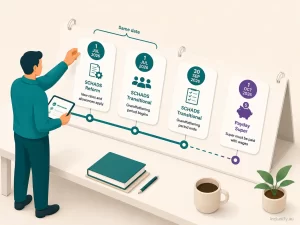
Here is the part that makes this a genuinely difficult year to still be running SCHADS through a spreadsheet or a payroll tool with no award interpretation logic. There is not one change to prepare for. There are four, and the first two land on the same day.
1 July 2026: the Annual Wage Review lands, and Payday Super starts on the same date. The Fair Work Commission’s Expert Panel handed down its Annual Wage Review decision confirming a 4.75% increase to every SCHADS Award minimum rate, effective from the first full pay period on or after 1 July 2026, according to law firm coverage from ABLA.
On the very same date, a completely separate reform takes effect nationally: Payday Super requires every employer to pay superannuation guarantee contributions on payday rather than quarterly, with funds generally required to land in an employee’s account within a set number of business days, as confirmed by the Fair Work Ombudsman.
For a provider still calculating super quarterly in a side spreadsheet, the same pay period that brings a wage increase also brings a structurally different super obligation, which is a lot to reconcile manually in one pay run.
1 October 2026: Schedule E gets an interim rise on top of that. In the same set of proceedings, the Commission found that pay rates for Schedule E employees, meaning home care workers delivering disability care, had been affected by gender-based undervaluation, since the role has historically been performed predominantly by women and paid less than comparable work in aged care despite no meaningful difference in the work itself.
The remedy, a Schedule E pay increase of approximately 15%, applies to those employees from the first full pay period on or after 1 October 2026, as confirmed by McCullough Robertson Lawyers and by the peak body NCOSS. If any part of your workforce delivers disability care in a home care setting, this rise applies on top of the July increase, not instead of it.
1 October 2027: the whole classification structure gets rebuilt. The same decision replaces the current Schedules B, C, E and F with a single, integrated classification structure across virtually all SCHADS employees. Every worker will need to be individually mapped, or translated, onto the new structure, with pay protection ensuring nobody’s rate goes backwards in the process, per the Victorian Council of Social Service. That is more than a year away, but the translation and budget modelling work the Commission is recommending providers start now takes months, not weeks.
Any provider still reconciling SCHADS by hand, or running software that requires someone to manually re-key new award rates every time the Fair Work Commission hands down a decision, is now looking at doing that exercise four separate times in eighteen months, each with a different effective date and a different slice of the workforce and payroll obligations affected. Providers running payroll and rostering through one connected system get each of these updates applied centrally, once, rather than chasing four separate manual re-keys across the same period.
Where underpayment actually happens
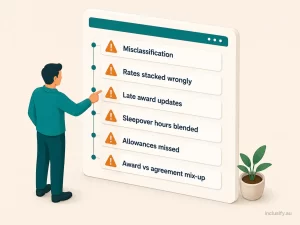
The failure points that turn up most often in Fair Work Ombudsman matters are rarely dramatic. They are small, structural gaps in how a payroll process handles the award, and they compound every pay run until someone notices, usually a worker querying their payslip rather than the provider catching it internally.
- Misclassification at onboarding.A worker is set up at the wrong level or pay point from day one, and the error repeats on every subsequent pay run until someone audits it.
- Penalty rates applied additively instead of taking the highest rate.A Saturday evening shift should be paid at the higher of the Saturday or evening penalty, not both stacked together, and the reverse mistake, applying the lower rate, is just as common.
- Award updates not reaching payroll in time.The classic failure mode: the Fair Work Commission’s new rates take effect on the first full pay period after 1 July, but the payroll system still has last year’s rates loaded on pay day.
- Sleepover and active work hours blended into one calculation.Paying the flat sleepover allowance for the whole shift when a worker was actually up and providing active support for part of the night.
- Allowances left out of casual loading calculations, or applied inconsistently between permanent and casual staff performing the same shift pattern.
- Enterprise agreement and award minimums confused.Where a provider has an enterprise agreement, payroll needs to apply whichever set of terms is more favourable to the employee, not simply default to the agreement.
One recent matter, involving a university operating disability and community services, saw more than $2.6 million back-paid to around 1,500 employees after root causes were traced to exactly this kind of misapplied wage increase and payroll misconfiguration, not deliberate wrongdoing. That is the risk profile complex-award payroll actually carries: not fraud, but drift.
It is also why an auditable trail matters as much as the calculation itself. If a payroll system can show, for any pay run, exactly which award clause and rate produced each line item, a compliance question becomes a five-minute report instead of a weeks-long reconstruction project pulled together from old spreadsheets and someone’s memory of how things worked eighteen months ago.
What the best payroll software for NDIS providers with complex awards actually needs to do
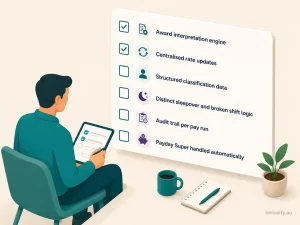
A lot of software claims SCHADS support, but not all of it is genuine award interpretation software. Far fewer vendors can actually demonstrate what that support looks like under the kind of scrutiny a Fair Work Ombudsman review applies. When you are evaluating options, these are the capabilities worth pressure-testing rather than taking on faith:
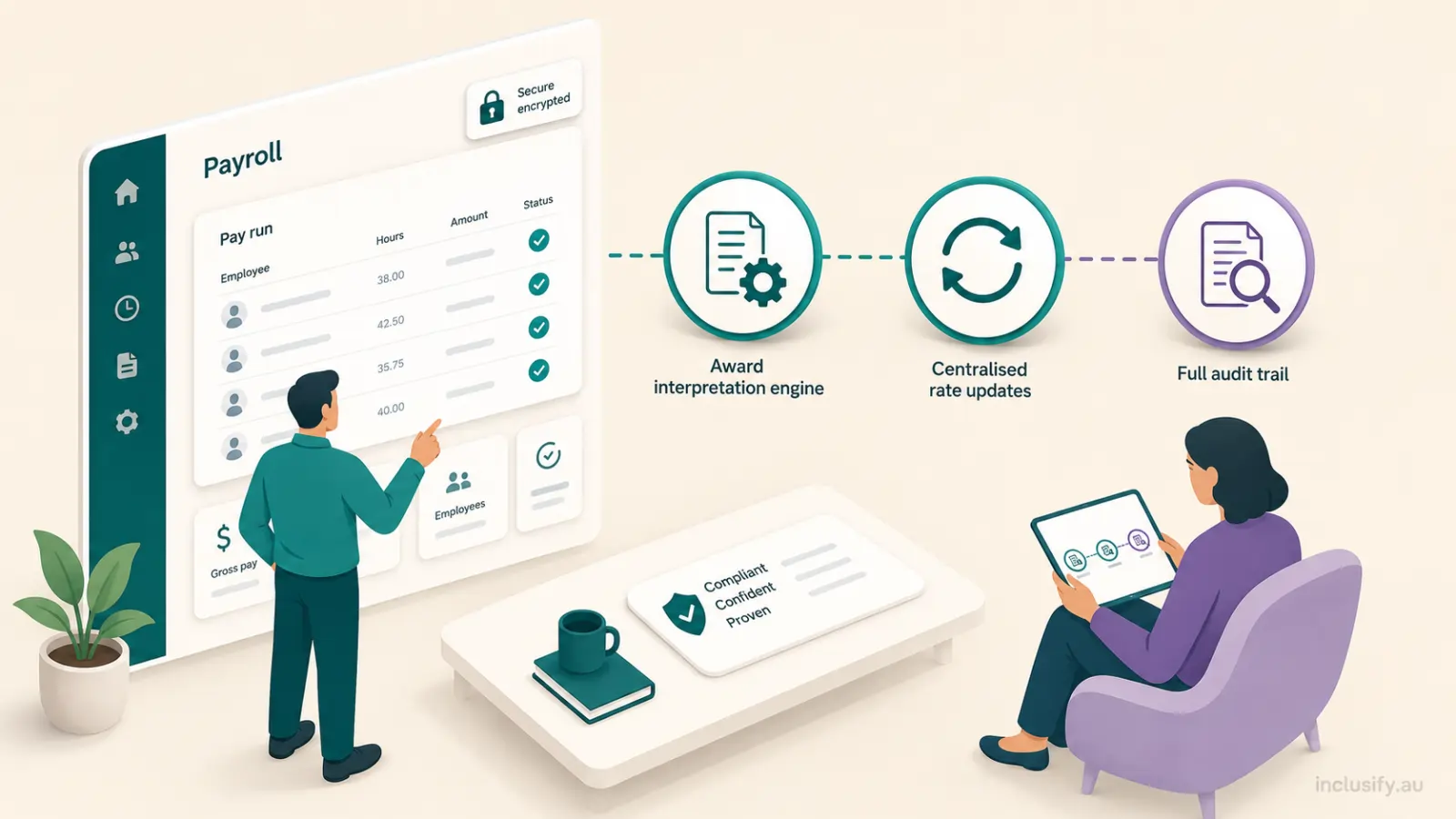
- An award interpretation engine, not a rate table.The system should calculate the correct penalty, allowance, and loading automatically based on the shift that was actually worked, rather than relying on a payroll officer to look up and manually apply the right multiplier every time.
- Centralised rate updates.When the Fair Work Commission hands down a decision, like the four landing between now and October 2027, the update should happen once, centrally, and flow through to every affected pay run rather than requiring a manual re-key across every employee record.
- Classification and stream held as structured data, not free text, so a worker’s level, pay point, and stream drive their pay automatically instead of depending on someone remembering to apply the right rule.
- Sleepover, broken shift, and on-call handled as distinct shift types, each with their own calculation logic, not forced into a generic start-and-finish timesheet entry.
- An audit trail on every pay run, showing which award clause and rate produced each line item, so that if the Fair Work Ombudsman does ask questions, the answer is a report rather than a reconstruction project.
- Payday Super handled as part of the same pay run, not as a separate quarterly process someone has to remember to run in parallel.
- A direct line from rostering to payroll to claims, so the shift that was rostered, the hours that were actually worked, and the amount claimed against a participant’s plan all trace back to the same record rather than three separate systems that can drift out of sync with each other.
This is the kind of gap that closes when rostering and payroll live in the same system rather than two disconnected tools. Inclusify’s timesheets, payroll and finance module carries approved time through to payroll with the shift’s full service context attached, so the record a support worker was rostered against is the same record their pay run is built from, rather than a payroll add-on that has to be told what happened after the fact.
Questions worth asking in an actual demo

Marketing pages are easy to write. A live system either handles SCHADS correctly or it doesn’t, and the fastest way to find out is to ask a vendor to show you the calculation, not describe it. Worth bringing to any demo:
- Roster a Sunday sleepover shift with two hours of active support in the middle of the night, and ask the system to calculate the pay outcome live. Does it produce two different rates for the sleepover portion and the active portion, or one flat number?
- Ask how a Fair Work Commission rate change actually gets applied. Is it a system-wide update the vendor pushes centrally, or a spreadsheet the provider has to re-key by hand?
- Ask to see an audit trail for a single pay run. Can it show, line by line, which award clause and rate produced each payment?
- Ask what happens to super under Payday Super. Is it calculated and scheduled automatically from the same pay run, or does it still require a separate quarterly process?
- Ask how a misclassified worker gets corrected. Is it a single field change that recalculates going forward, or a manual rebuild of every affected pay run?
These are worth bringing to a conversation with any vendor, Inclusify included. You can see how rostering, timesheets and payroll connect on the platform page. The pricing page also shows what that capability looks like across the Independent, Growing, and Established tiers.
Frequently asked questions
What makes the SCHADS Award harder to pay correctly than other awards?
The combination of eight classification levels across four streams, penalty rates that depend on the highest applicable rate rather than stacking, and shift types like sleepovers and broken shifts that don’t map to a simple start-and-end timesheet. Between stream, level, pay point, and employment type, there are more than 3,000 possible pay rate combinations.
When does the SCHADS Award pay rate increase in 2026?
The Annual Wage Review increase of 4.75% applies from the first full pay period on or after 1 July 2026. A separate interim increase of approximately 15% applies to Schedule E, home care disability, employees from the first full pay period on or after 1 October 2026, per McCullough Robertson.
Does the Schedule E pay rise apply to all disability support workers?
No. It applies specifically to employees currently covered by Schedule E, meaning home care employees delivering disability care. It does not extend to disability support workers in a community setting or to other home care streams, as confirmed by NCOSS.
What is Payday Super for NDIS providers?
Payday Super is a national superannuation reform, not specific to NDIS or SCHADS, requiring employers to pay superannuation guarantee contributions at the same time as wages rather than quarterly, from 1 July 2026. It applies to every employer with super obligations, including NDIS providers, according to the Australian Taxation Office.
What is the SCHADS Final Classification Structure?
A single, integrated classification structure that will replace the current Schedules B, C, E, and F from 1 October 2027, with every employee individually mapped onto the new structure and pay protection so no one’s minimum rate falls, according to the Victorian Council of Social Service.
Can generic payroll software handle SCHADS correctly?
Only if it includes a genuine award interpretation engine for SCHADS specifically. Generic systems typically require a payroll officer to manually apply the correct penalty, allowance, and classification rules, which is exactly where the underpayment failure points described above tend to originate.
The bottom line
Providers searching for the best payroll software for NDIS providers with complex awards are really asking whether their systems can survive an award that changes on four different dates across the next eighteen months, without a payroll officer having to manually re-apply every new rate by hand. Generic timesheet-and-pay-run tools were never built to answer that question.
Software with genuine SCHADS award interpretation built in, tied directly to the roster and to claims, is no longer a nice-to-have for providers with more than a handful of staff, it is the only realistic way to stay ahead of a regulator that has already named this sector a priority.