


What actually changed on 1 July 2026
Supported Independent Living has always been one of the highest-risk support types in the NDIS: paid, often overnight, support delivered inside someone’s home. Until recently, it was also one of the least regulated. SIL could be delivered by registered and unregistered providers alike, and unregistered providers operated with no requirement to meet Practice Standards, undergo audits, or demonstrate compliance.
That changed from 1 July 2026. The Albanese Government confirmed that mandatory registration for SIL and platform providers would begin from that date, alongside a new set of SIL Practice Standards built specifically for in-home and shared-living support, rather than adapted from generic provider standards. The reform follows findings from the NDIS Review, the Disability Royal Commission, and two NDIS Commission own-motion inquiries, all of which identified gaps in participant safety, tenancy rights, and provider accountability inside SIL and group-home settings.
If your organisation delivers SIL, or is thinking about it, this SIL Practice Standards checklist is the starting point for getting your SIL provider registration status sorted, your evidence in order, and your everyday Supported Independent Living compliance ready for what the NDIS Commission is now actually auditing against.
The new registration group: 0138
The Commission has created a dedicated registration category for this support type: Registration Group 0138: Assistance with Supported Independent Living. How you get there depends on where you’re starting from.\
If you’re already registered for SIL
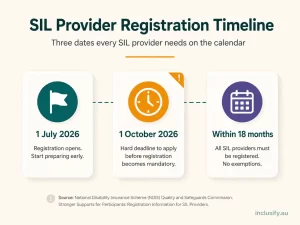
Providers currently registered under the old category, 0115: Assistance with Daily Life Tasks in a Group or Shared Living Arrangement, don’t need to submit a new application. The NDIS Commission automatically transitions this registration to Registration Group 0138. What does change is the audit. Providers must complete a Module 5A certification audit as part of their mid-term audit, which must commence no later than 18 months after the start of the current registration period. That audit assesses how the SIL Practice Standards are applied in everyday work, not just whether the policy documents exist.
SIL provider registration if you’re not yet registered, or SIL is new to your service offering
New and previously unregistered SIL providers go through the standard variation-of-registration process, engaging an Approved Quality Auditor who determines whether an out-of-cycle certification audit is required before the registration group is added. Applications lodged before 1 July 2026 fall under the old 0115 category; applications from that date use 0138 directly, and are assessed against the new SIL Practice Standards from the outset.
The timeline matters here. Providers already delivering SIL without registration have a transition window, but it isn’t indefinite: applications must be submitted by 1 October 2026, and new entrants to the SIL market from 1 July 2026 onward cannot deliver SIL supports at all until the Commission has actually granted registration for it. This isn’t a soft deadline to plan around eventually. If your organisation is delivering SIL today without being registered for it, the clock is already running.
Module 5A: the four SIL Practice Standards
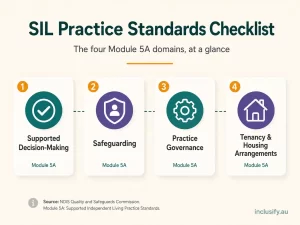
The new Module 5A standards sit alongside the existing NDIS Practice Standards Core Module, which every registered provider already has to meet. Module 5A adds four SIL-specific domains, and understanding what each one actually requires is most of the battle before an audit.
1. Supported Decision-Making
The standard is built around a specific distinction: decisions made by participants, not decisions made for them. In practice, auditors are looking for evidence that participants were genuinely offered choice and control, not just support delivered in a way staff judged to be in their best interest. That evidence usually lives in participant records and support plans, and it needs to show the process, not just the outcome.
2. Safeguarding
This domain covers protection from violence, abuse, neglect, and harm, balanced against a participant’s right to dignity of risk. Practically, this is where restrictive practice authorisations, incident records, and structured follow-up on safety concerns get tested. A single missed incident follow-up or an expired behaviour support authorisation is exactly the kind of gap auditors are trained to find.
3. Practice Governance
Governance in this context isn’t a policy folder. It’s whether the organisation can show it uses incident data, complaints, and audit findings to actually change how it operates: corrective actions traced back to specific incidents, internal audits scheduled and completed, and documented continuous improvement rather than a one-off policy review.
4. Agreements about tenancy, housing and support arrangements
This standard exists because SIL and Specialist Disability Accommodation often overlap, and participants have historically had unclear tenancy rights when their landlord and their support provider are the same organisation. Providers delivering both housing and support need written agreements that keep tenancy and support arrangements clearly separate, so a participant’s home isn’t conditional on their support arrangement.
What auditors actually check
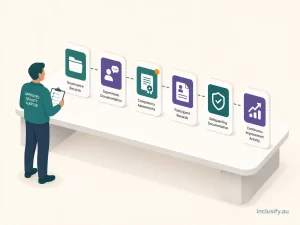
This is the part most compliance content skips. An NDIS Commission audit against Module 5A doesn’t stop at do the policies exist? Current audit guidance shows auditors examine whether systems work in practice, through records, staff files, participant evidence, and direct interviews, drawing on a specific evidence set: governance records, supervision documentation, competency assessments, participant records, safeguarding documentation, and continuous improvement activity. If that evidence is scattered across shared drives, a whiteboard in the office, and whatever a support coordinator remembers from six months ago, an audit will find the gaps in your Supported Independent Living compliance before you do.
A working SIL Practice Standards checklist

Treat this as a starting working document for your next NDIS Commission audit, not a substitute for engaging an Approved Quality Auditor or reviewing the Commission’s own Evidence Guide.
SIL provider registration and timing
- Confirmed whether the organisation is already registered under 0115 (auto-transitions to 0138) or needs a new variation of registration application for 0138
- If unregistered and currently delivering SIL, application submitted well ahead of the 1 October 2026 cut-off
- Mid-term audit date confirmed with your Approved Quality Auditor, and checked against the 18-month commencement requirement
- Named individual or team owns SIL compliance day to day, not just at audit time
Supported Decision-Making
- Participant files show evidence of choice and control being offered, not only support delivered
- Staff training records demonstrate capability in supported decision-making practice, not just attendance at a session
Safeguarding
- Restrictive practice authorisations current and on file for every participant they apply to
- Incident records show structured follow-up through to resolution, not just the initial report
- Worker screening checks current for everyone delivering SIL supports
Practice Governance
- Policies dated, version-controlled, and reviewed on a defined schedule
- Continuous improvement register links corrective actions back to specific incidents, complaints, or audit findings
Tenancy and housing arrangements
- Written agreements clearly separate tenancy arrangements from support arrangements where the organisation delivers both
- Participants have a documented, accessible pathway to raise a housing or tenancy concern separately from a support complaint
Where this actually goes wrong
In practice, the standards themselves aren’t usually where providers fall down. It’s the evidence trail. A support worker follows the supported-decision-making process correctly in the home but nothing about it is captured in the participant record. A restrictive practice authorisation lapses because nobody was tracking the expiry date against a spreadsheet nobody remembered to open that week. An incident gets logged but the follow-up lives in someone’s inbox instead of a system an auditor can actually pull evidence from.
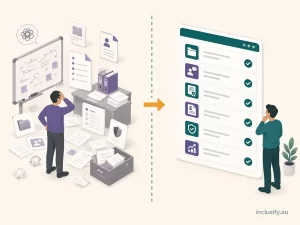
This is really an operational problem wearing a compliance costume. Providers evaluating NDIS software for SIL providers are usually looking for exactly this: a system where duty packs, incident records, worker screening status, and participant documentation live in one place with exception management flagging what’s about to lapse, rather than living across five disconnected tools and someone’s memory. Inclusify’s approach to this is built around exactly that gap: keeping the evidence an SIL audit actually asks for current and centrally visible, so preparing for a mid-term Module 5A audit is a matter of pulling a report, not reconstructing six months of records under time pressure.
The bottom line
SIL Practice Standards are no longer a future compliance project. Mandatory registration commenced 1 July 2026, the transition window for unregistered providers closes 1 October 2026, and every provider delivering SIL, existing or new, is now being assessed against Module 5A’s four domains: Supported Decision-Making, Safeguarding, Practice Governance, and tenancy and housing arrangements. The organisations that come through their next audit cleanly won’t be the ones with the most polished policy folder. They’ll be the ones who can produce evidence, on request, that these standards are actually how they operate day to day. Use the SIL Practice Standards checklist above as a starting point for ongoing Supported Independent Living compliance, and treat it as a living document you revisit before every audit cycle, not a box you tick once.
For a broader look at the regulatory changes reshaping provider obligations this year, see our earlier breakdown of the NDIS Integrity and Safeguarding Act 2026, and how Inclusify approaches day-to-day compliance tracking for registered providers.

Frequently asked questions
Do all NDIS providers need to comply with Module 5A?
No. Module 5A applies specifically to providers delivering Supported Independent Living under Registration Group 0138. Providers who don’t deliver SIL continue to be assessed against the Core Module and whatever other supplementary modules apply to their services.
What is Registration Group 0138?
It’s the dedicated NDIS Commission registration category for Assistance with Supported Independent Living, introduced from 1 July 2026 to replace the previous 0115 category for SIL-specific purposes.
Do currently registered SIL providers need to re-register?
No. Providers already registered under 0115 have their registration automatically transitioned to 0138 by the NDIS Commission. What changes is that their next mid-term audit, which must commence within 18 months of the current registration period starting, will assess compliance against the new SIL Practice Standards.
What happens if a provider misses the registration deadline?
Unregistered providers already delivering SIL must have their application submitted by 1 October 2026 to continue operating during the assessment process. Providers entering the SIL market from 1 July 2026 onward cannot deliver SIL supports at all until registration is actually granted, not merely applied for.
What evidence does an NDIS Commission audit against Module 5A actually look for?
Auditors assess governance records, supervision documentation, competency assessments, participant records, safeguarding documentation, and continuous improvement activity, and they test whether documented procedures are genuinely reflected in day-to-day practice through file reviews, staff interviews, and participant evidence, not only whether policy documents exist.
Can I use this SIL Practice Standards checklist as an actual compliance guarantee?
No. This checklist is a practical starting point for internal readiness, not a substitute for guidance from an Approved Quality Auditor or the NDIS Commission’s own Evidence Guide. Requirements can be updated by the Commission after publication, so always verify current obligations directly before an audit or registration deadline.
Does dedicated NDIS software for SIL providers actually help with Module 5A compliance?
It helps with the part providers usually struggle with, which is evidence, not policy. Purpose-built NDIS software for SIL providers keeps supervision documentation, incident follow-up, worker screening status, and participant records centrally visible and dated, so the evidence an auditor asks for is a report away rather than a reconstruction project.